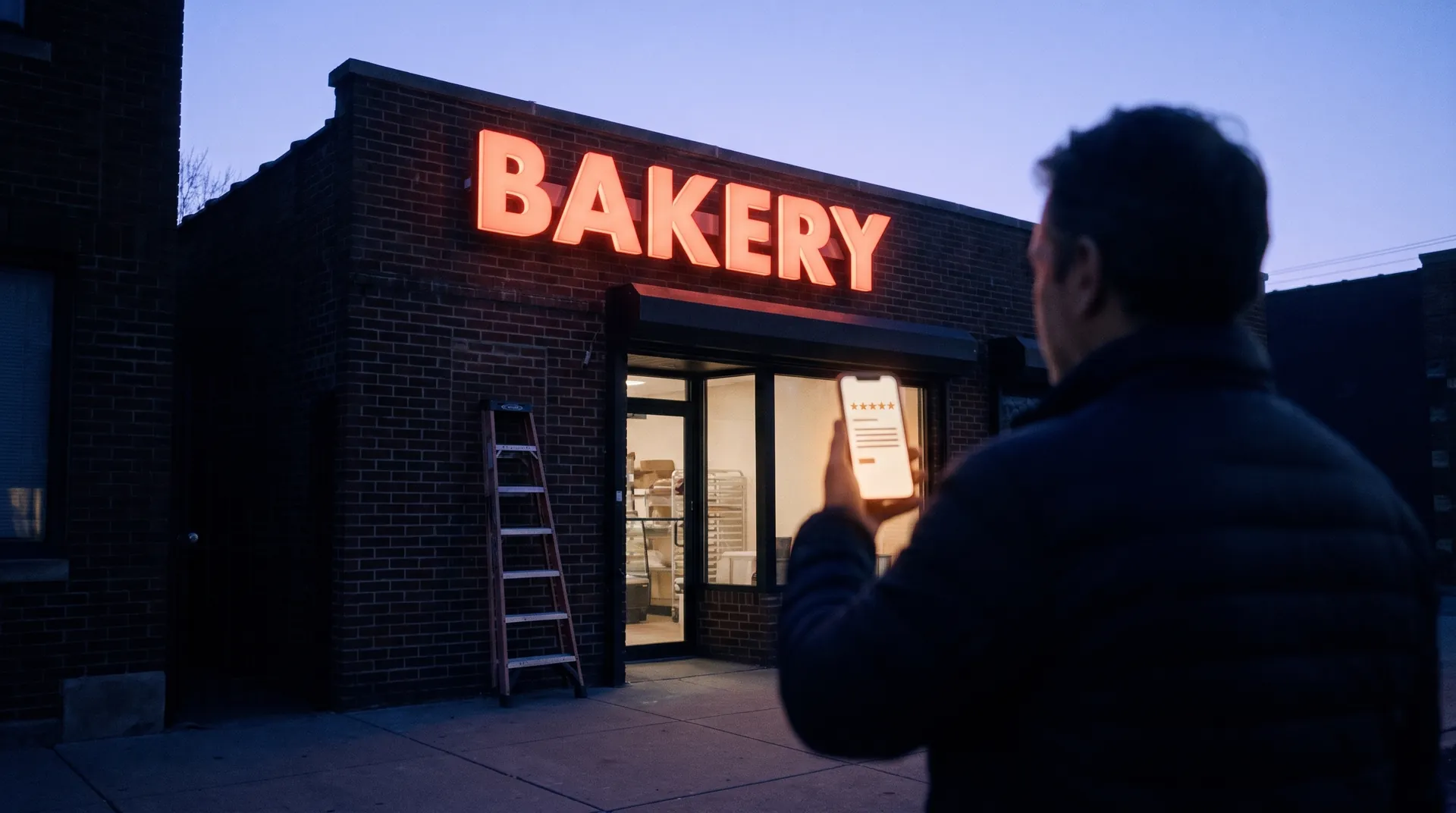
Follow-up
Why reviews matter even when you're busy
Many shops on sign forums say they are full. They get most of their work from referrals and repeat customers, and their limit is how much the crew can build, not how many calls come in. One owner wrote, "I get most of my business through referrals and repeat customers." If that is you, you might wonder why you would ask for reviews at all.
The answer is the quality of the work, not the quantity. Reviews help you land the jobs you want. A property manager choosing a vendor, a business owner opening a second location, or a general contractor hiring a sign shop will usually read the reviews before they call. A shop with good ones looks safe. A shop with none looks like a gamble.
Reviews also help when the pipeline changes. Owners who are new, or who have moved their shop, report a different problem. One wrote, "Turns out I have all but disappeared from Google, I don't show up in search results at all and on the map results I'm way down the list." Another said the website leads and word of mouth that had always worked were not bringing in as much as before. Finding work comes up in about forty threads.
Reviews are a slow, steady asset. They keep working while you are on a lift. The ones you collect this year will still be on your listing in the year you do need them.
The best moment to ask
Ask right after the install.
That is when the sign is lit or hung, the customer is looking at it, and the job feels good. A week later, they are back to their day. A month later, the review is a chore. The same customer who would have written a few warm sentences in the parking lot will not write them in a follow-up they have to remember.
If you or your crew are on site at the end of the job, ask in person. "If you're happy with it, would you mind leaving us a Google review? I'll send you the link." It takes a few seconds, and it sets up the text that comes next.
Be specific about what you are asking for. People say yes to "a short review of the install" more easily than to "a review." If your crew does good work, give them permission to ask. Most installers are shy about it until someone tells them it is part of the job.
Ask every customer. A shop that only asks the customers it thinks will love it ends up with an uneven set of reviews and a few surprises.
Make it one tap
Most people who intend to leave a review never do, because it takes too many steps. They have to find the listing, find the button, sign in and type. Each step loses some of them.
Make it one tap. Your Google listing has a direct link that opens the review box. Send that link in a text right after the install, with a short thank-you. Use email for customers without a mobile number, or who haven't agreed to texts. The customer taps the link, picks a star rating, writes a line or two, and is done.
The message does not need to be fancy. "Thanks for choosing [Shop]. If you're happy with the sign, a quick Google review helps us a lot: [link]." That is enough.
Sending it by hand works. The weakness is remembering, since you will forget on the busy weeks, which is when you have the most installs. A message that goes out automatically when a job is marked installed removes the remembering.
Send one reminder a few days later if they have not tapped the link, and then stop. A second reminder starts to feel like pressure.
Ask everyone the same way. Do not screen for who seems happy, and do not offer a discount or a gift for a review. Google's rules do not allow either, and customers can tell.
What to do with a bad one
If you ask for reviews often enough, you will eventually get a bad one. Plan for it before it happens.
First, wait a day. Your first reaction will not be your best.
Then reply, once, in public. Thank the person for the feedback. Say what you understand went wrong, in one or two sentences, without excuses. Offer to fix it, and give a way to reach you directly. Future customers will read your response more closely than the review. A calm answer shows how you treat people when something goes wrong, which is what they are trying to find out.
Do not argue, and do not describe the customer's mistakes in public, even when they are real. Do not ask them to take it down in exchange for a refund. If the problem was real, fix it, and if they are happy, they may update the review themselves.
If a review is fake, such as from someone who was never a customer, you can flag it to Google. Check your records before you decide it is fake.
Look at the pattern, too. One bad review is an event. The same complaint showing up again and again is a process problem, and the reviews just told you where.
Winton Consulting's review requests send the review link by text or email to each customer when a job is marked installed, follow up once if it has not been tapped, and then stop. Every customer is asked the same way.
Put the ideas to work.
Keep reading
More articles.
Follow-up
Bringing back past customers: faded signs, new locations, rebrands
Your old job list holds customers who already trust you. A scheduled check-in tied to the sign they bought gives them a reason to call again.
Follow-up
Following up on a quote without being a pest
Quiet quotes come up less often than people assume. When one does go quiet, a short, polite check-in beats waiting and wondering.

Quoting
Getting every detail for a sign quote on the first try
Owners on sign forums say the slow part of quoting is getting details out of the customer. Asking the right questions up front cuts the back-and-forth.